By the luck of the draw, my name was pulled out of the hat by Stanley and Harriot to be my host family on Barbados. Actually, it was me that lucked out!
After a morning of orientation for our upcoming month in the Windward Islands of the Caribbean, lunch with Rotarians from all three Barbados Rotary clubs and a beach afternoon at the Barbados Yacht Club, Harriot picked me up and surprised me with a personal tour of Barbados Prime Minister David Thompson's residence! Apparently, Anne Marie (Stanley and Harriot's 17-year old daughter) is best friends with the Prime Minister's daughter.
Although I was unable to take photos inside, they allowed me to take several photos from the upstairs outdoor pool of the grounds - the grounds are used for a variety of events. In fact, the Rotary Club of Barbados does its largest fundraiser on this beautiful property.
We arrived last night a few minutes late at the airport in Bridgetown, Barbados. We were met by GSE Coordinator Joe Steinbok and a group of Rotarians from the three Barbados Rotary clubs.
We were just enveloped in hospitality from these wonderful Rotarians - we felt like relatives coming home rather than a team of five strangers from the Pacific Northwest. We like to think of ourselves at home as friendly and hospitable, but these people must have the patent.
This morning, we met with Joe and Barbados Rotarian Stanley MacDonald at Joe's office for our initial orientation on what we will be doing for the next month here in District 7030. The coordination that must occur for any GSE team is a challenge - now imagine doing that for clubs on four different Caribbean islands that are all different countries - the air travel arrangements alone are astounding. We presented a small token of appreciation to Joe for his efforts on behalf of District 5110 GSE Co-Chairs Justin Baird and Chandra LaHusen.
The district here has set up a packed vocational and cultural exchange program on the four islands - each island has its own character. On a personal aside, we noted that they did build in a few tourist stops for us - the small piece of Barbados we have seen thus far has been like walking though a post card.
We are off tomorrow to the island of Dominica, where we will be for next week. We will begin our vocational exchanges there as well as making a team presentation to the Rotary Club of Dominica on Wednesday.
We received our final itinerary yesterday - we are going to Martinique, a department of France, after all.
February 28 (RED) - arrive Barbados from home March 1-2 - Barbados (orientation) March 2 (BLUE) - fly to Dominica March 3-6 Dominica March 7 (GREEN) - boat to Martinique March 7-13 - Martinique March 14 (YELLOW) - fly to Saint Vincent March 14-18 - Saint Vincent March 19 - Bequia (Grenadine Island) March 20 (BROWN) - fly to Barbados March 21-27 - Barbados March 28 (PURPLE) - depart Barbados for home
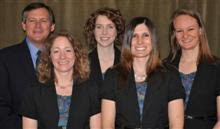
Liane Richardson has had to drop out of the exchange. The team will miss her sense of humor, but understands the issues that have caused her to make this decision.
Okay, some good news.
Heidi Ellis, our first alternate, who has been a key contributor during our team training, is stepping in.
Barbados is an independent West Indian Continental Island nation. For over 300 years it was a colony of the United Kingdom and still maintains Queen Elizabeth as its head of state. Barbados declared independence in November of 1966.
Barbados is considered part of the Lesser Antilles. It’s total land area is about 166 square miles. The island is predominantly made up of limestone-coral and is the only part of the North Atlantic submarine mountain range that actually rises above sea level.
The climate is tropical, with consistent trade winds which keep its temperatures mild. Some areas of the country have tropical woodland and mangroves, while other parts of the interior are dotted with large sugarcane estates and pastures.
The largest city of Barbados is also its capital, Bridgetown. The Country’s motto is “Pride and Industry”, and its Human Development Index is consistently among the top 75 countries in the world; its third in the Americas behind Canada and the United States. The official language is English, but there are three recognized regional languages: Bajan, Hindi, and Bhojpuri. The population as of July 2006 was 279,00 people. 90% of the population are Afro-Bajan, 6% Asian and Multiracial, and 4% European. The government of Barbados is a parliamentary democracy and a constitutional monarchy.
The currency is the Barbadian dollar. The time zone is Eastern Caribbean. People drive on the left. The calling code is +1 (246).
History According to accounts from descendants of the aboriginal Arawak tribes, the original name for Barbados was Ichirouganaim. Haven’t been able to figure out what that meant or how you pronounce it. The Portuguese, en route to Brazil, are credited with discovering and naming the island. Barbados means “bearded”, but they don’t know if the name was given because of the long, hanging roots of the bearded fig-trees, to the bearded Caribs who inhabited the island, or to the foam that sprays over the outlying reefs and give the impression of a beard. Other names associated with Barbados are “Bim”, “Bimshire”, or “De rock”. These words were typically used by slaves and meant “my people”.
The first inhabitants are thought to have been Amerindians who arrived from Venezuela around 350-400 B.C. The Arawak people were the second wave, arriving from South American around 800. In the thirteenth century, the Caribs arrived from South America, displacing the Arawak culture. For the next few centuries, the Caribs lived in isolation on the island. The Portuguese briefly claimed Barbados from the mid-1500’s to the 1600’s and used the Caribs as slave labour. Apart from displacing the Caribs, many of whom fled to other neighboring islands, the Portuguese left little impact on the island and left for South America by the 1610’s, leaving the island uninhabited.
British sailors arrived in 1625, and from then until the declaration of independence in 1966, Barbados was under British control. Black or slave codes were implemented, which created differential treatment between Africans and white workers, and made the island unattractive to poor whites. An increasingly repressive legal system caused the gap between the treatment of typically white indentured servants and black slaves to widen. Planters imported African slaves for this reason, and the inhabitants of Barbados turned from mainly English and Scots-Irish in the seventeenth century to overwhelmingly black by the end of the 18th century.
Barbados had one of the world’s largest sugar industries after Jews from Brazil introduced sugarcane to the island in the mid 1600’s. This quickly replaced tobacco as the main export. Slave trade was abolished in 1807, but slavery itself lived on. In 1816, slaves arose in the largest major slave rebellion in the island’s history. Twenty thousand slaves from over 70 plantations rebelled. Slavery was finally abolished 17 years later in 1834. In Barbados, full emancipation from slavery was preceded by an apprenticeship period that lasted four years.
Historically, Barbados law was based entirely on English common law with a few local adaptations. At the time of independence, British law and various legal statutes within British law at the time became the basis of the modern-day law system. More recently, adaptations have been made based on organizations such as the United Nations and the United States Constitution.
Parishes Barbados is divided up into eleven parishes, of similar geographic size. Only two, St. George and St. Thomas, are without coastlines, being located in the middle of the country.
Economy Barbados is the 51st richest country in the world in terms of the gross domestic product per capita. They have a moderately high standard of living, and a well-developed mixed economy. Historically the economy was dependent on sugarcane cultivation, but in the late 1970’s it diversified into manufacturing and tourism. Offshore finance and information services have become important foreign exchange earners. The island has also seen a construction boom, with the development and redevelopment of hotels, office complexes and homes.
Tourism The island is well developed, and there are internationally known hotels offering world-class accommodation. Time-shares are available, and many of the smaller local hotels and private villas which dot the island have space available if booked in advance. The southern and western coasts of Barbados are popular, with the calm light blue Caribbean Sea and their fine white and pinkish sandy beaches.
Along the island's east coast the Atlantic Ocean side are tumbling waves which are perfect for light surfing, but a little bit risky due to under-tow currents. Shopping districts are popular in Barbados, with ample duty-free shopping. There is also a festive night-life in mainly tourist areas such as the Saint Lawrence Gap.
Other attractions include wildlife reserves, jewelry stores, scuba diving, helicopter rides, golf, festivals (the largest being the annual crop over festival July/Aug), sightseeing, cave exploration, exotic drinks and fine clothes shopping.
Gary and Norma Anderson
Bi-Mart
CHETCO Federal Credit Union
Jim Coffee Studios
Glory Bee
Kerr Resources
Oregon Dept of Transportation
Sweet Life
University of Oregon Bookstore
Winter River Books
Wooden Nickel Myrtlewood


.jpg)

.jpg)
